Home batteries are the fastest-growing part of the Cyprus solar market, and fire safety is now part of the public debate. In a television interview on 10 November 2026, a Fire Service spokesperson said that lithium battery fires are hard to extinguish. He also said the Fire Service wants home batteries installed outdoors, in a separate fire-resistant structure. The Fire Service has sent its views to the Interior Ministry, and no rules have been adopted yet.
The concern is fair. But the battery in a 2026 home system is not the battery in an old laptop, and installation rules in other countries are more nuanced than "outdoors only". This article explains what changed, what the evidence says, what the standards require and what a sensible owner should do.
The short version
Lithium-ion fires are real and can be severe. In home storage they are rare: depending on the count, the yearly risk is between 1 in 10,000 and 1 in 20,000 systems.
Modern home batteries mostly use LFP (lithium iron phosphate) cells. In laboratory tests, LFP reacts more slowly and at higher temperatures than older chemistries. It is not fireproof.
The UK standard for home batteries allows indoor installation in some places and bans it in others. None of the standards compared below require a separate building.
Modern batteries add layers of protection: good cells, a battery management system and, in some models such as the Pytes V16, built-in fire suppression.
Where the battery goes, and who installs it, matter as much as the cells.
1. Why older batteries earned their reputation
Early lithium-ion batteries used cathodes based on cobalt oxide, and later nickel-manganese-cobalt (NMC) or nickel-cobalt-aluminium (NCA). These chemistries store a lot of energy in a small, light cell. That is why they power phones, laptops and many electric cars.
They also have a weakness. If a cell is damaged, overcharged or overheated, it can start to heat itself in a chain reaction called thermal runaway. Layered-oxide cathodes can release oxygen as they overheat, which helps the fire continue and spread to nearby cells.
Two points keep this fair. Many famous failures came from manufacturing faults, not from chemistry alone. Samsung's investigation of the Galaxy Note 7 in 2017 found two separate defects: a bent electrode in the first battery, and welding burrs with missing insulation in the replacement. Both were design and manufacturing problems. And older lead-acid home batteries had hazards of their own, such as hydrogen gas while charging. They were just more familiar.
2. How common are home battery fires?
Hard numbers are scarce. The most useful study comes from RWTH Aachen University, published in the Journal of Energy Storage in 2025. The researchers counted battery-caused fires in Germany from media and web reports. They found about 37.5 for 2023, against about 768,000 home storage systems installed on average that year. That gives an annual probability of about 0.0049% per system, roughly 50 times lower than for a general house fire (0.28%). The study put tumble dryers at 0.0037% and refrigerators at 0.0012%.
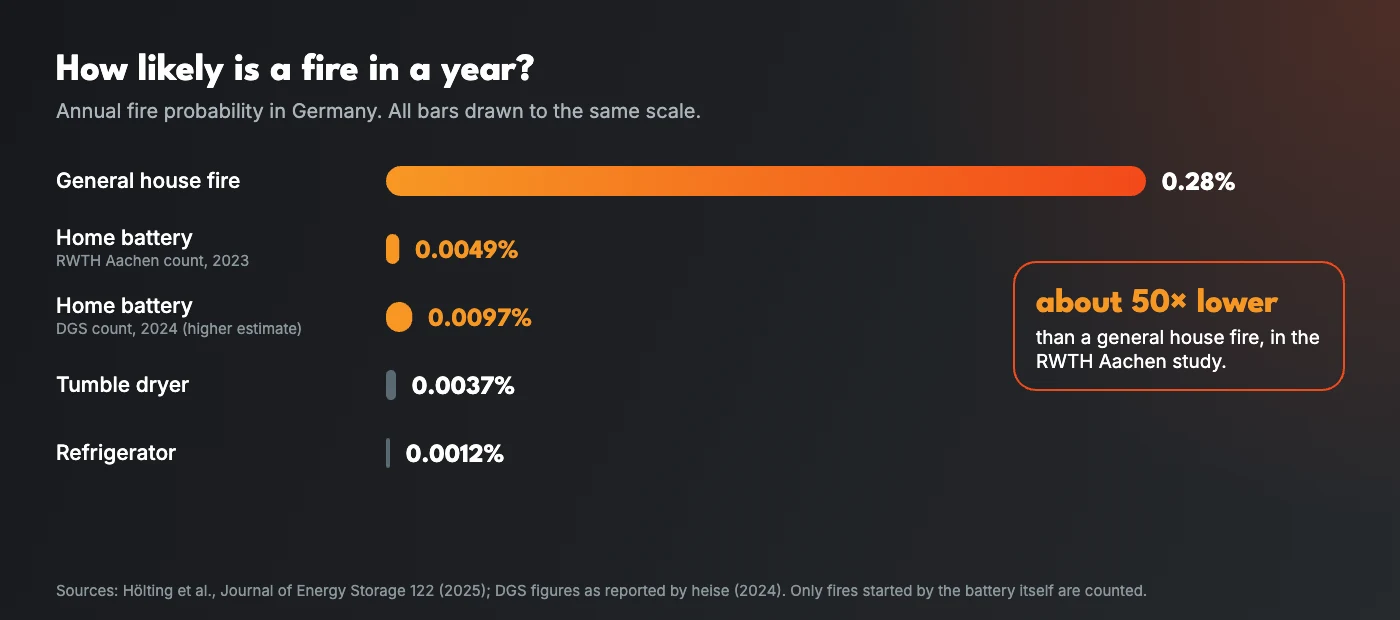
A few notes on these numbers:
The count includes only fires started by the battery itself. It excludes fires caused by human error or faulty wiring.
A separate count by the German Solar Society (DGS) is higher: 18 cases in 2022, 49 in 2023 and 57 in 2024. Even so, it gives about 0.01% for 2024.
The DGS expert notes that most fires in his data involve LFP batteries, partly because LFP is now the most common chemistry. LFP is safer in tests, not risk-free in the field.
Both counts rely on public reports, so treat them as an order of magnitude.
3. What LFP changes
LFP cells use iron phosphate in the cathode. Its structure is more stable under heat, and it tends to hold its oxygen more tightly. In practice, lab results point the same way. Researchers at KIT tested 21700-format cells in 2023. LFP cells reacted more slowly and at significantly higher temperatures than NMC and NCA cells. In their nail-penetration test, no LFP cell went into thermal runaway. Under heating, LFP cells at 0% and 30% charge did not run away below 350 °C.
LFP stores less energy per kilogram, which matters little for a battery that sits on a wall. It also lasts longer: the Pytes V12 and V16 datasheets list 6,000 and 8,000 cycles. The Pytes V12 and V16 and the AlphaESS SMILE-G3 batteries in our range are all LFP.
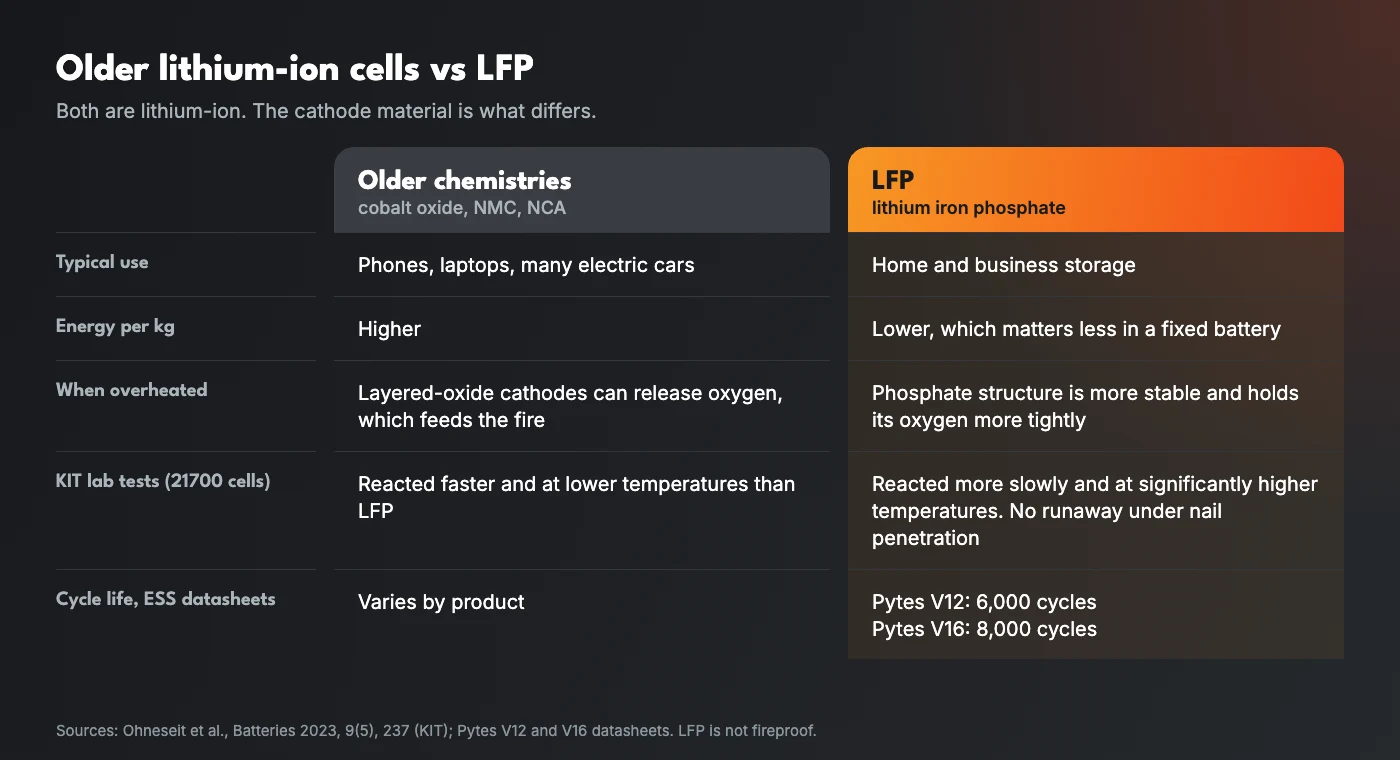
What LFP does not mean. It is not fireproof. A badly damaged or defective LFP battery can still burn. Fires of any lithium-ion chemistry release toxic gases, so smoke from a battery fire should always be avoided. A good battery management system, correct wiring and a sensible location still matter.
4. The layers of protection in a modern battery
A safe battery does not rely on the cell chemistry alone. Pytes, the manufacturer of the V12 and V16 batteries we supply, describes three layers of protection in its V16:
The cells. They come from Tier 1 manufacturers. Pytes says these cells have been in stable use for many years, with their safety proven in long-term real-world use.
The battery management system (BMS). It monitors the state of the cells in real time. If it detects a problem, it raises an alert and cuts the circuit.
Fire suppression. The V16 has a built-in module that releases an aerosol if the battery overheats, which displaces the oxygen.
Together, these layers lower the probability of a battery fire. They do not remove the risk, which is why the installation and the location still matter. Fire suppression is a feature of the V16, so check the datasheet of the model you are considering.
5. What the standards say
There is no single European rulebook for where a home battery may go. Product safety is tested to international standards such as IEC 62619. Installation rules are national, and they vary.
The UK: PAS 63100:2024
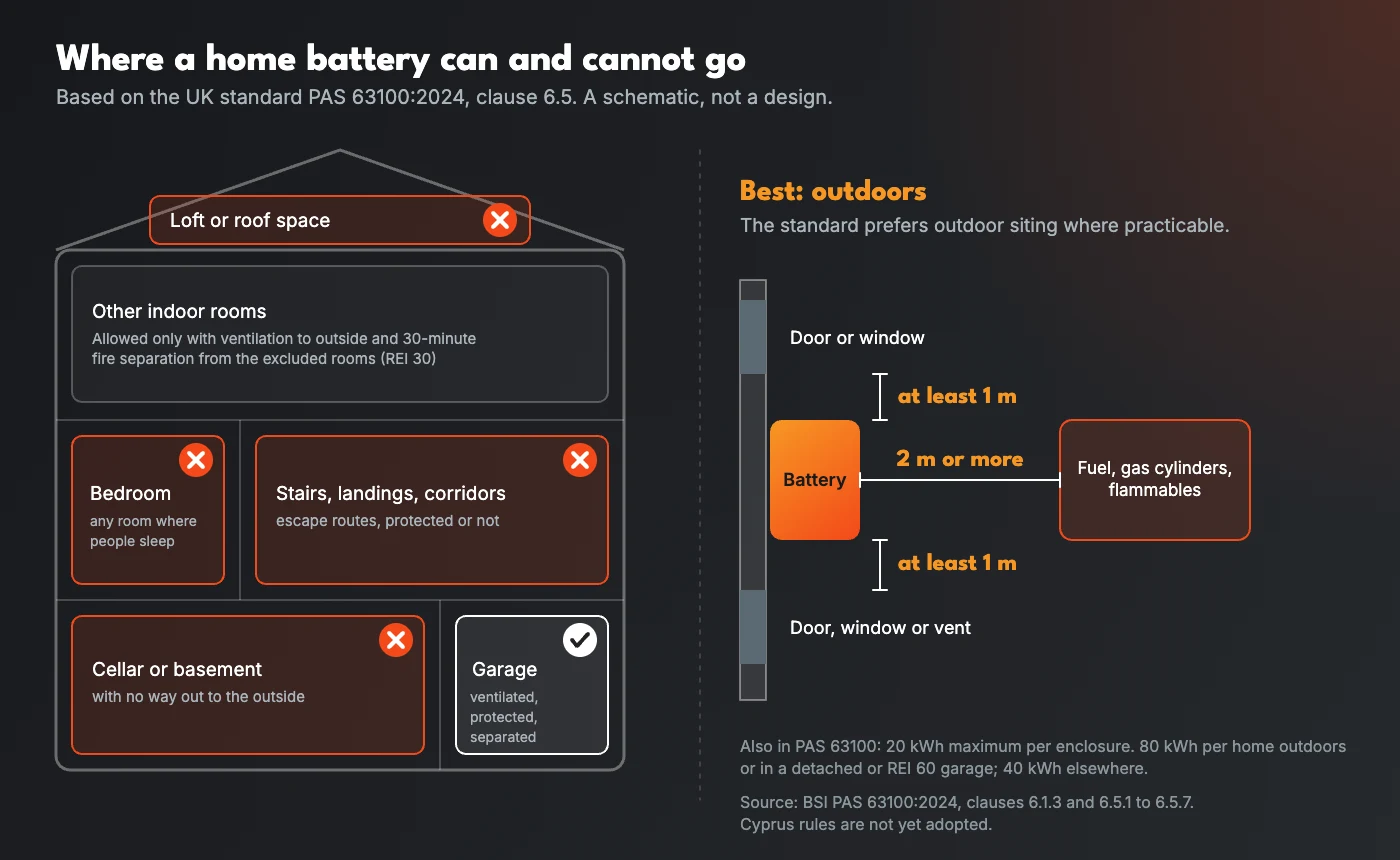
The UK has a published standard written for homes. Its main points:
Install batteries outdoors where practicable.
No batteries in rooms where people sleep, in cupboards or spaces opening into them, or in escape routes, including landings, staircases and corridors.
No batteries in lofts, roof spaces or voids, or in cellars and basements with no access to the outside.
Other indoor locations, such as garages, are allowed with ventilation to the outside and at least 30 minutes of fire separation from the excluded rooms.
Outdoors, no battery within 1 m of an escape route, door, window or ventilation port, and no battery within 2 m of fuel, gas cylinders or other flammable material.
A smoke or heat detector, linked to the home alarm, where the battery is in a rarely visited place such as a store cupboard.
Limits of 20 kWh per enclosure, and 80 kWh per home outdoors or in a detached or fire-separated garage (40 kWh elsewhere).
Other countries
| Country | Rules and guidance |
|---|---|
| Germany | VDE-AR-E 2510-50 covers stationary lithium storage. Guidance from the German fire brigade association (vfdb, 2026) lists a non-combustible floor, 600 mm of free access in front of the unit, clearance from combustible material, and a smoke detector and extinguisher as recommended. It does not require a separate building. |
| Netherlands | PGS 37-1 is the Dutch guideline for energy storage systems. |
| United States | The residential code and NFPA 855 allow up to 40 kWh in utility spaces and 80 kWh in garages or outdoors, with limits per unit and spacing between units. |
This is not a full list of national rules, and there is no single European rule. None of the standards above require every home battery to sit in a separate fire-rated building.
And in Cyprus?
As of 31 August 2026, Cyprus had no dedicated legal framework for home batteries (Politis). The Fire Service circulated safety guidance to electricians in April 2025 and sent recommendations to the Interior Ministry. ETEK and the electrical and mechanical services drafted installation standards broadly aligned with the UK rules. The Fire Service has not fully accepted them. According to Kathimerini (May 2026), the Fire Service reportedly wants batteries installed outside and at least 2 m from doors and windows, against 1 m in the UK-style draft. Officials quoted in the same report estimate that the stricter approach could exclude up to three-quarters of households.
The rules may change, so ask your installer which requirements apply on the day of installation.
6. Reasonable precautions for a home battery owner
Before you buy
Choose a battery from an established manufacturer. Ask which safety standards it is tested to, such as IEC 62619, and ask for the certificates.
Prefer LFP, and check the datasheet.
Use a licensed installer, and ask them to explain where the battery will go and why.
Where to put it
Outdoors in a shaded, protected spot is best. A garage is a common indoor choice.
Keep the battery out of bedrooms, escape routes, lofts and basements with no way out.
Keep paint, fuel, gas cylinders and other flammable items away from it. Leave room for ventilation.
Avoid direct sun and standing water. For outdoor use, choose a battery with a suitable ingress rating, such as IP65 or IP66.
While you use it
Fit smoke alarms in the home. PAS 63100 recommends interlinked alarms (at least Grade D2, Category LD2) for any home with a battery. Test them every month.
Keep the app and firmware up to date, and do not ignore fault alerts.
Look at the battery now and then. Swelling, a hot casing, a strange smell, unusual noise or repeated alarms mean you should stop using it and call your installer.
Never open, modify or stack batteries yourself.
If something goes wrong
Leave the building and call 112. Tell them that a lithium battery is involved.
Do not try to fight a battery fire yourself, and do not breathe the smoke.
Damaged lithium-ion batteries can reignite hours or days after a fire. This is documented mainly for electric cars. Keep the area out of use until a professional has checked it.
The bottom line
Modern LFP home batteries are a mature technology, and the available data shows a low fire risk. Safe use comes from a good product, a careful installation and the right location. The open question in Cyprus is not whether home batteries can be used, but under which installation rules. We will update this article when the rules are published.
Planning a home battery? Talk to the ESS team about the right system and where to place it.
Sources
BSI, PAS 63100:2024, Protection against fire of battery energy storage systems for domestic premises.
Hölting et al., "Quantitative fire likelihood assessment of battery home storage systems", Journal of Energy Storage 122 (2025), 116599. doi.org/10.1016/j.est.2025.116599. Coverage and DGS figures: heise.
Ohneseit et al., Batteries 2023, 9(5), 237 (KIT). doi.org/10.3390/batteries9050237.
Samsung Galaxy Note 7 investigation, 23 January 2017, as reported by PCWorld.
vfdb, Aufstellort von PV-Batteriespeichern (2026).
UL, Residential ESS separation and maximum quantities (2021 IRC).
Politis, Legal Gap Persists as Home Battery Demand Surges (31 August 2026).
Kathimerini, via now.solar (18 May 2026).
AlphaNews Live, interview with the Cyprus Fire Service spokesperson (10 November 2026).
Pytes V12 and V16 and AlphaESS SMILE-G3 datasheets. Pytes statement on the protection layers of the V16.